
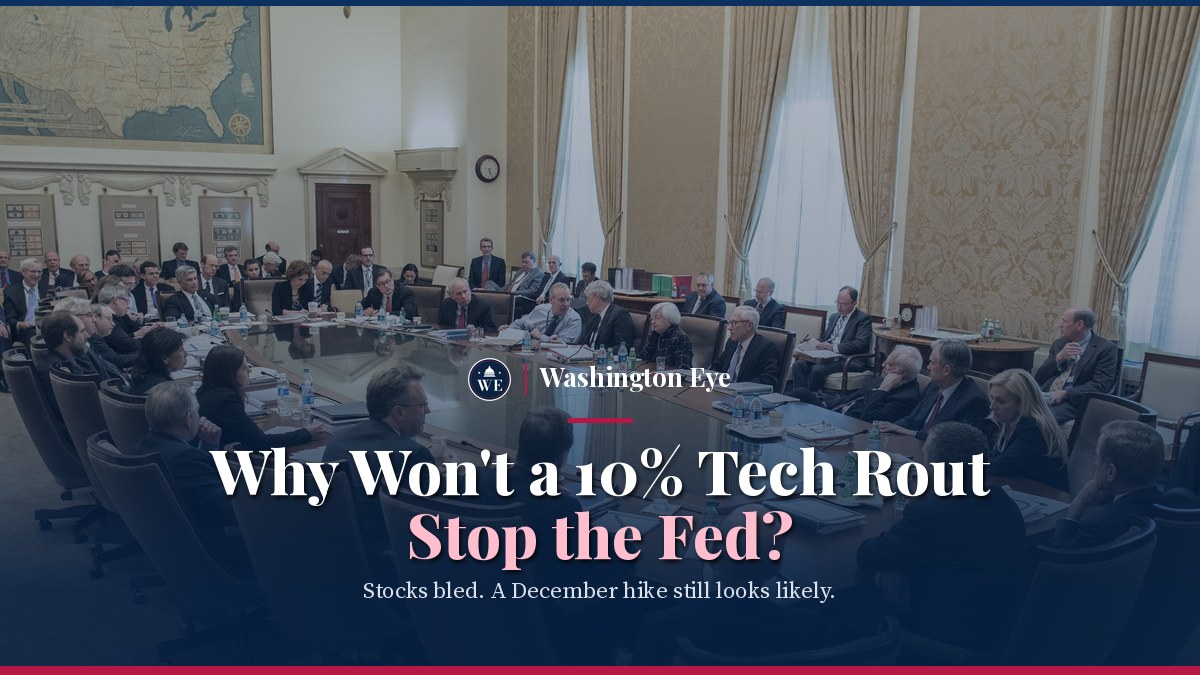
Wall Street has just lived through the kind of week that usually makes central bankers flinch. The Nasdaq 100 lost 10.4% in five trading days, its worst week since the pandemic crash of March 2020. The S&P 500 fell 8.6% and closed below 7,000, the twelfth worst week for the index since 1952. A gauge of expected market turbulence jumped 86%, one of its largest leaps in more than two decades. Gold, copper and the currencies of commodity exporters fell with it.
And yet, on the morning after, traders still put the odds of a Federal Reserve rate increase at its December 8 and 9 meeting at roughly 97 to 98%. The only bet the rout really killed was the one on a bigger move. Less than two weeks ago, futures markets gave a half point hike a real chance. Now they give it almost none. The question for Washington, and for anyone with a mortgage, a business loan or a retirement account, is why a market shock this large has done so little to change the Fed's plan.
The short answer is inflation. The longer answer runs through a public quarrel between the Treasury and the central bank, a Fed chair who has deliberately gone quiet, and a single report due on Wednesday that could tip the decision either way.
The week that broke the AI trade
The selling began in technology and spread outward. Investors who had ridden artificial intelligence stocks through a four year bull market started asking hard questions about the return on enormous, sometimes debt financed spending on data centres. The sudden departure of Nvidia's chief executive, Jensen Huang, shook confidence in the company that supplies the chips at the centre of the boom. Strong Nvidia earnings did not calm nerves, and neither did Anthropic's record setting stock market debut, whose early pop faded within days, although the shares remain above their offering price.
By Friday the tech heavy Nasdaq Composite had fallen more than 5% in a single session. Investors fled to government bonds. The ten year Treasury yield slipped back below 5%, and the two year yield, which tracks expectations for Fed policy most closely, posted its biggest drop since August 2025. Stock futures bounced sharply early on Monday, with contracts on the Nasdaq 100 up almost 3% before the opening bell in New York, but one good morning does not undo a week like that.
In ordinary times, a sell off of this size would push the Fed toward caution. Falling share prices make households feel poorer and companies more careful, which does some of the central bank's cooling work for it. Economists at Bank of America estimate that the moves in asset prices since the Fed's October meeting have tightened financial conditions by roughly as much as two quarter point rate increases. That is the heart of the case for going slowly. It is not, so far, winning.
The Treasury's case: do not overdo it
Treasury Secretary Scott Bessent has been making that case loudly all month. In a Sunday television interview he pointed to a run of hawkish comments from Fed officials and warned of the consequences. "Many people believe that they may be making a policy mistake if they overtighten," he said. "We've seen a substantial tightening in financial conditions over the past few months."
Mr Bessent offered several reasons for the slide. He said the selling began as Democrats moved ahead in the polls and accelerated after Election Day, arguing that the party's stance on slowing the AI build out had spooked investors. He named the Fed's tone as another factor. On Nvidia, he said the government would look into the company's chip sales to China and who oversaw compliance, while insisting the firm remains "fantastically profitable" with "near unlimited demand for their chips worldwide."
His argument on rates is consistent. Earlier this month he said the Fed should understand that the country is dealing with "an energy supply shock" tied to the war with Iran, and that the shock is already easing. "To hike too much into an energy supply shock when it's coming down, these are very noisy numbers," he said in a business television interview on November 13. "The Fed's supposed to look into the future, not look in the rearview mirror." A week later he urged officials not to back a larger increase. He has not said publicly what December outcome he wants, and he has not named the officials he disagrees with.
It is unusual, though not unheard of, for a Treasury secretary to lean on the Fed this openly. The remarks will not decide anything on their own; the Treasury does not vote on rates. But they set up a clear political frame. If the economy stumbles in 2027, the administration has now put on record that it warned the central bank first.
The Fed's case: this is not just oil
Inside the Fed, the mood is very different, and the data explain why. Inflation has run above the central bank's 2% target for nearly six years. The consumer price index rose 0.4% in October, and the core measure, which strips out food and energy, rose 0.3% for the third month in a row. Core inflation on the Fed's preferred gauge, the personal consumption expenditures index, stood at 3.1% in September.
Governor Christopher Waller, once one of the board's more dovish voices, has become its loudest hawk. "Let's just say it. September's inflation data were bad. There was no silver lining," he said in a speech on November 10. He told his audience that price increases had spread to core goods and to market based services, and that Fed staff research suggested energy shocks may now pass through into wider prices more stubbornly than they did before the pandemic. More recently he has argued that if the Fed will not clearly signal a January hike, "then you have to go 50 in December to put it in place and get it done."
Chicago Fed President Austan Goolsbee answered Mr Bessent almost directly, on the same business channel the same morning. "The tariff inflation and oil price shock were supposed to have gone away by now and it hasn't," he said, adding that services inflation, "which is probably not coming from tariffs or oil," was among the most troubling parts of recent reports. Asked last week about a larger December move, Mr Goolsbee, who becomes a voting member of the rate setting committee in January, would not rule it out. "Everything's always on the table at every meeting," he said.
Not everyone at the Fed is in a hurry. New York Fed President John Williams and Cleveland Fed President Beth Hammack have both said they prefer a more gradual path. But the minutes of the October meeting showed that almost all officials expected further increases to be appropriate, and a couple raised the possibility of a half point move if inflation readings stayed unfavourable. They did.
There is also a growth argument for staying firm. The economy expanded at a 3.4% annual rate in the third quarter, unemployment is 4.1%, and the Atlanta Fed's tracking model put fourth quarter growth at 3.2% as of last week, led by a surge in business equipment spending. The AI build out itself adds to price pressure, driving up demand for electricity, construction and specialised equipment. Producer prices for electronic components rose almost 32% in the year to October. A central bank looking at those numbers sees an economy that is still running hot, whatever the stock market did on Friday.
A chair who stopped talking
One reason the debate feels so noisy is that the person who would normally settle it has chosen not to. Fed Chairman Kevin Warsh has largely abandoned forward guidance, the practice of hinting at what the central bank will do next. He wants markets to watch the data rather than parse speeches. The result has been the opposite of quiet. Bank of America economists counted more public appearances by Fed officials over the past two weeks than in any comparable stretch since the start of 2025.
That matters for more than market commentary. A half point increase in December followed by a pause would have very different effects on borrowing costs than a string of quarter point moves stretching into spring. Without a signal from the chair, investors are left to weigh each official's comments against the others. Goldman Sachs economists expect quarter point increases in December and March, taking the benchmark range to 4.25% to 4.5%, and think a half point move in December faces a high bar. Futures markets see roughly even odds of a further quarter point increase in March.
What to watch this week
The holiday shortened week is light on data but heavy on consequence. Markets close on Thursday for Thanksgiving and shut early on Friday. Everything important lands on Wednesday.
The October PCE report. Forecasters expect core prices to rise about 0.3% for the month, pushing the annual rate to 3.2% or 3.3% from 3.1%, and headline inflation to reach about 3.8%, nearly twice the Fed's target. A reading at or above those forecasts would revive talk of a half point move. A softer one would strengthen the Treasury's hand and could pull a December pause back into the conversation.
The second estimate of third quarter growth. The first estimate showed 3.4%. A revision up would reinforce the view that the economy can take higher rates.
The Beige Book and jobless claims. The Fed's survey of regional business conditions will show whether the market slide is already denting spending and hiring on the ground. Weekly jobless claims, brought forward because of the holiday, have been running near 200,000, a sign of a labour market that is still tight.
Beyond this week, the November jobs report on December 4 is the last major release before the Fed meets.
Our read
The Fed is not ignoring the market. It is betting that a stock correction, however painful, is a smaller danger than inflation that has stayed above target for most of a decade and is now spreading beyond oil and tariffs. Mr Bessent is betting the opposite: that the energy shock will fade by itself and that the central bank risks hitting the brakes just as the AI investment cycle turns.
Both bets carry real costs. If the Fed is right, a quarter point increase in December is an insurance payment against a more painful fight in 2027. If the Treasury is right, the Fed will be tightening into a slowdown it helped create. For now the market's verdict is clear enough. A 10% tech rout bought investors relief from the prospect of a bigger hike, not from a hike itself. Wednesday's inflation number will show whether even that relief lasts.