
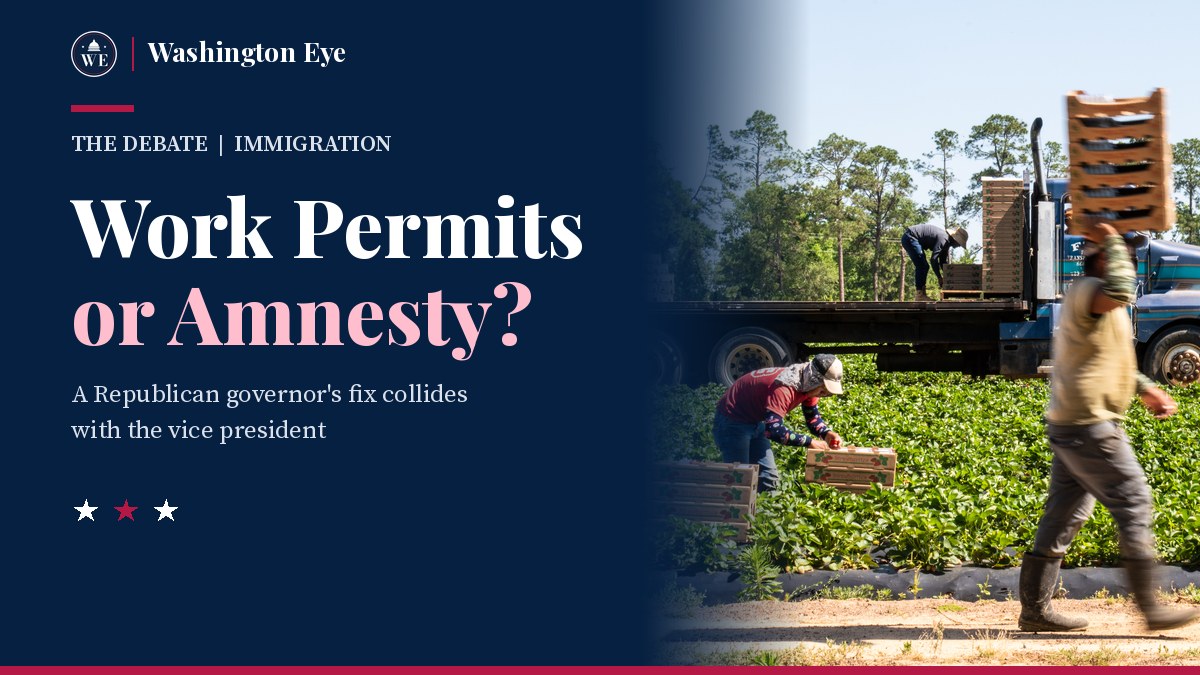
Kevin Stitt thinks the answer is simple. Oklahoma's Republican governor told a forum of new governors in Park City, Utah, on Wednesday that America's immigration fight could be settled with one idea: if an employer vouches for a worker, the worker's state should be able to hand over a permit to work. "Period, end of story," he said. By Thursday morning the vice president of his own party had answered him in public, and the answer was no.
"I like Kevin, but what does 'bipartisan immigration reform' mean?" JD Vance wrote in a post online. "If you mean making it harder for megacompanies to defraud our visa system, great. If you mean we should pass legislation to make it harder for employers to violate our immigration law, I'm all ears. But to a lot of people, this sounds like an effort to give amnesty to people who have broken our laws. It is morally and electorally disastrous."
Stitt fired back that what he wants "is not amnesty." Oklahoma's incoming lieutenant governor, T.W. Shannon, also a Republican, weighed in too, saying Stitt did not speak for him or for most Oklahomans and that there should be no amnesty. A quarrel between a governor and a likely 2028 presidential contender has become the clearest preview yet of the argument Republicans will have to settle once a Democratic Congress arrives in January. Below, we set out the strongest version of each side.
How a governors' idea reached the vice president
Stitt did not invent the work-permit pitch this week. As chairman of the National Governors Association earlier this year, he argued that governors are closer to the labour needs of their states than anyone in Washington, pointing to farms in Oklahoma and the fisheries of Maryland. In August, sitting beside Utah Governor Spencer Cox, he asked Congress to give governors discretion to issue migrant work permits. Cox, who leads a bipartisan governors' task force on the issue with Delaware's Democratic governor Matt Meyer, put the pitch in five words: "Work permits, can we start there?"
The same month, Utah Senator John Curtis, a Republican, introduced a bill to create a voluntary state-sponsored visa programme, with Arizona Democrat Mark Kelly as a cosponsor. As a libertarian think tank describes it, states would opt in, the Department of Homeland Security would approve each state plan, the status would last three years at a time and be renewable, total numbers would be capped at 500,000, and states could sponsor some people who have been in the country since the end of 2016 even if they are now out of status. The bill has not had a committee vote.
What changed this week was the political weather. Republicans lost both chambers of Congress on November 3. Days later, President Trump told a Sunday television interviewer that his deportation push had been "too tough" and that "ultimately, that hurt me," adding: "I'd love to do something on immigration." He suggested that immigrants with steady jobs in hotels and landscaping, whose only offence was entering illegally, might be allowed to stay. Then, on November 9, he told reporters, "There won't be amnesty," and he has since elevated Stephen Miller, the architect of his deportation policy, to White House chief of staff. Stitt is trying to pull the president toward the first version. Vance is pulling toward the second.
The case for Stitt: the border is closed, so fix the rest
The governors' argument starts from a fact Republicans like to repeat. Border encounters, which reached about 300,000 a month under President Joe Biden, have fallen to roughly 10,000 a month under Trump. For decades, Republicans said they would not discuss work visas or legal status until the border was under control. "For 40 years, we've been trying to do immigration reform and nobody's ever been able to get it done," Cox said in August. "But what's different this time is that we have a secure border." If that condition has been met, the reform camp argues, refusing to move now looks less like principle and more like a permanent veto.
Second, they say the plan is not amnesty in the sense voters fear. Stitt has said he does not believe in "just automatically giving U.S. citizenship." A state work permit, as he describes it, is tied to a job and an employer, and it can be withdrawn. "We need to have a strong border. We need to know who is coming into our country. We need to vet those people," he said on Wednesday. The pitch is order, not open doors: deport criminals, keep the border shut, and bring the workers employers already rely on out of the shadows and onto the books.
Third, there is the human and economic case, which Stitt made personal. He pointed to Hai Nguyen, a Vietnamese refugee who came to Oklahoma in 1993 at the age of eight, graduated from the University of Oklahoma, and worked at Hobby Lobby for 15 years with a federal work authorisation renewed every year. A 2006 marijuana possession charge, later expunged, left an old removal order on his record. In March, immigration agents detained him at a routine appointment, and he spent 93 days in custody before a judge granted his release. Stitt argued that the permission Nguyen had been given to work should be honoured. After a fatal shooting by a Border Patrol agent in Minneapolis in January, Stitt had already asked aloud what the administration's "endgame" was. Cases like Nguyen's are his answer to why the question matters.
Finally, there is the electoral claim. Stitt said Washington politicians on both sides think they are "winning" on immigration and try to "crush the other side," and that "that's why you saw this huge swing in the midterms." Even the president has said publicly that the toughest parts of his policy hurt him.
The case for Vance: a permit is the first step to staying
Vance's side starts with a different fact: the people Stitt's plan would cover broke the law to get here or to stay. A permit that lets them keep their jobs, renewable every few years and open to people who arrived nearly a decade ago, is legal status in all but name. The restrictionist reading of the Curtis bill is exactly that: whatever it is called, a document that turns unlawful presence into lawful work is a reward, and rewards invite more of the behaviour being rewarded. Vance's own line is that he is "all ears" on punishing employers and fixing visa fraud, but not on forgiving the workers.
Second, the vice president's camp says the tools already exist. The 1986 law that made it illegal for employers to knowingly hire unauthorised workers is still the backbone of workplace enforcement, and Vance's offer amounts to enforcing it harder rather than rewriting it. To his side, "bipartisan reform" is a phrase that too easily becomes legal status first and enforcement later.
Third, the politics may not be what Stitt says. Vance called the idea "electorally disastrous," and the backlash from Stitt's own incoming lieutenant governor suggests the Republican base has not moved. Even Homeland Security Secretary Markwayne Mullin, who told governors in August that the country does need reform, drew an outcry from conservative commentators and responded in a post online: "NO amnesty for illegal aliens. Ever." A party that just lost Congress may be tempted to blame its tone rather than its policy, and to protect the issue that brought its voters out in the first place.
Fourth, there is a constitutional objection that cuts against state permits whatever one thinks of the merits. Under federal law, only Washington can authorise a noncitizen to work. In 2012 the Supreme Court struck down part of an Arizona law on the ground that Congress had built a comprehensive federal system for the employment of noncitizens. Utah passed its own guest-worker law in 2011, but it needed a federal waiver that never came. Handing that power to fifty governors, critics argue, would create fifty immigration systems and invite blue states to issue permits on a scale red states would never accept.
Texas shows why the fight will not stay theoretical
The quarrel is already spilling into states where the balance of power just flipped. In Texas, Democrats won every statewide seat on November 3 and took the state House. Governor-elect Gina Hinojosa said in an interview with a Texas news site that "what ICE is doing is making us less safe. We should not facilitate that," and signalled she would review outgoing Governor Greg Abbott's order directing state agencies to help federal agents. Houston Mayor John Whitmire issued an executive order on November 6 telling police not to contact immigration agents during routine traffic stops, and the state attorney general's office has renewed a lawsuit against the city.
Mullin warned that if Texas stopped cooperating, it "would be one of the worst derelictions of duty we've seen in a very long time." That is the enforcement side of the same fight: if governors gain a role in deciding who may work, they will also claim a role in deciding who gets handed over. Vance's camp sees that as the danger. Stitt's camp sees it as the reason Washington should write the rules now, while a Republican is still in the White House to shape them.
Where we come out
Both sides are right about something. Stitt is right that "secure the border first" has largely been achieved by the administration's own measure, and that a party which cannot say what comes next will keep losing voters like the ones who rallied around Hai Nguyen. Vance is right that any permit open to people already here unlawfully is a form of legalisation, and that Republicans owe voters a plain word for it rather than a softer label.
The honest test for the next Congress is narrow. A deal that pairs mandatory workplace verification and real penalties for employers with time-limited, job-tied permits that carry no path to citizenship would be closer to Vance's own stated terms than he admits, and further from amnesty than his post implied. If Republicans cannot accept even that, they should say so. If Democrats insist on citizenship as the price of any deal, they will hand Vance the argument he wants. The governors have put a smaller bargain on the table. In January, both parties will have to decide whether they want a deal or the issue.