
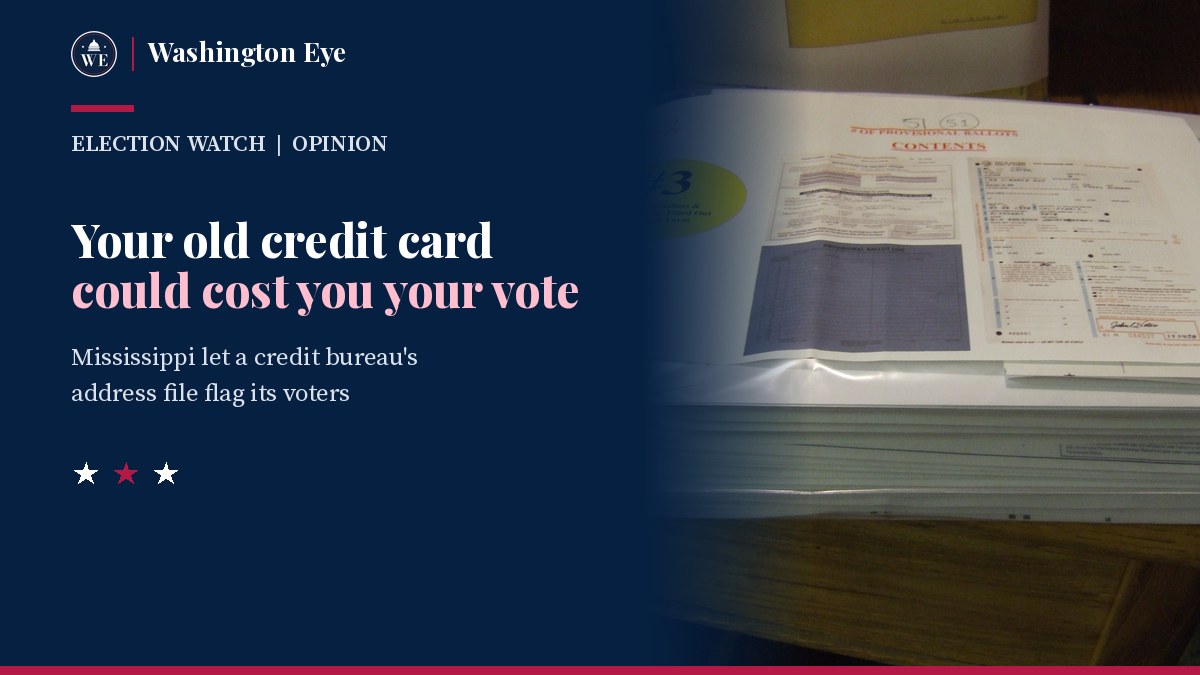
Kailyn Lott voted for the first time in 2024, at a fire station in Starkville, Mississippi. When she went back to the same fire station for this month's midterms, her name was not in the poll book. She had been marked inactive. Standing at the front of the line for an affidavit ballot, she learned why: her registration had been tied to her parents' house in Pontotoc County, an address she said was linked to an old credit card she opened as a kid.
That is the whole scandal in one sentence. A state that asks its voters to prove who they are at the polls let a credit bureau's address file help decide who was still a voter at all, and then told the people it got wrong that the system had worked exactly as designed.
We think Mississippi owes its voters something better than that answer, and the fix is not complicated.
How a $50,000 shortcut reached the poll book
The facts are not seriously in dispute. Before the November 3 election, more than 230,000 Mississippians were listed as inactive on the voter rolls, up from about 171,000 at the time of the 2024 presidential election. That jump of nearly 60,000 came after the office of Secretary of State Michael Watson, a Republican now running for lieutenant governor, signed a $50,000 contract with Experian, one of the country's big three credit reporting companies, to supply address data for voter roll maintenance. The state first tried the data in a pilot in Lafayette County in early 2024. Watson called the pilot a success, and address lists drawn from it went out to all 82 counties.
It was the first time Mississippi had relied on anything other than government records, chiefly Postal Service change of address data, to flag voters who might have moved. County election commissioners then used the lists to decide whom to move to inactive status. Inactive voters are not purged right away. But they vanish from the regular poll book, they must cast an affidavit ballot, which is what Mississippi calls a provisional ballot, and if they neither vote nor correct their status across two federal general elections, they can be removed entirely.
Experian itself has been blunt about what its product was. A company spokesperson said this month that the firm has not provided services to the state since early 2025, and that what it supplied "consisted of supplemental address information and was not designed or intended to validate voter records." Records released by the secretary of state's office show the contract carried Experian's disclaimer that it could not guarantee the "accuracy or reliability" of its data. The state has since stopped using Experian and moved to another data broker, IDI Data, along with Postal Service records. On Election Day, Watson wrote in a post online that his office had a "new vendor with more features and info than the last."
So the vendor that sold the data says it was never meant for this. The state has dropped it. And yet the inactivations it helped produce are still on the books.
The people the list got wrong
Thomas Minor has lived in Itawamba County his whole life. The address list placed him in a Delta town 160 miles away that he says he has never set foot in. At the March primaries his name was missing from the poll book. Poll workers handed him a ballot envelope but, he said, not the affidavit ballot itself, and in his rush to get to his shift at a Toyota plant he left without casting a vote. It was the first election he had missed in 12 years. "It makes me think he doesn't care about the voting process," Minor said of the secretary of state.
On Election Day the same story repeated at scale. Jamie Gunnells, an election commissioner in Lee County, which takes in the Tupelo area, was seeing so many inactive voters four hours after the polls opened that he posted a public warning about a "major disruption" caused by what he called the "Experian fiasco." He said some frustrated voters left without casting an affidavit ballot at all.
Watson's reply put the blame on people like Gunnells. "Ultimately, no matter what data is sent to the election commissioners, you should understand your job is to verify the information before acting upon it," he wrote. Gunnells and other commissioners said they were never told to check the Experian lists for errors. "I mean, how are we gonna verify it?" Gunnells asked. Under state law, it is the secretary of state who is responsible for training county officials to do this work.
Days before the election, a coalition of civil rights groups including the NAACP Legal Defense Fund, the ACLU of Mississippi and the Southern Poverty Law Center wrote to Watson asking him to restore to active status anyone inactivated on the strength of the Experian data. "The voters on this list did nothing wrong," the letter said. "Restoring them to active status does not weaken list integrity." The office did not act on the demands. An assistant secretary of state replied that no third party had the authority to dictate election law and that the statewide system was in a blackout period in which no systematic roll maintenance was allowed.
That reply skips an important detail. Mississippi law bars officials from inactivating or purging voters in the 90 days before a federal election. It places no such bar on moving a voter back to active status. The door to fixing the error was open. The office chose not to walk through it.
The secretary's case, taken seriously
Watson has a defence, and it deserves a fair hearing. In a statement on November 16 he called reports that 230,000 voters were removed at once "an egregious lie," saying that figure is the total marked inactive by local officials over more than five years of routine maintenance, many of them people who had died or moved. He said the 2025 data, which mixed Postal Service records with commercial information, flagged about 113,000 people for review, and that "not a single voter was made inactive or removed from the voter rolls without review by a local election official." He noted that a federal election agency had tested Experian data in a pilot under the Biden administration, and that when he took office in 2021, seven counties had more people on their rolls than eligible voters living there.
His strongest number is the affidavit count. Mississippians cast 21,484 affidavit ballots in 2026, he said, nearly identical to the 21,321 cast in 2024, and about 75 percent were approved and counted. In his telling, the safety net caught the errors, counted the eligible votes and rejected the improper ones.
Some of that is fair. Voter roll maintenance is required by federal and state law. Rolls swollen with the dead and the departed are a real problem, and a Republican official who cleans them is doing his job, not suppressing anyone. It is also true that many voters flagged in error were able to cast a ballot that counted.
But the safety net argument proves less than it claims. A flat affidavit total does not tell you how many affidavit voters this year were there only because of a bad address match, and it says nothing about the people, like some of those Gunnells saw, who gave up and went home. A 75 percent approval rate statewide also hides wide gaps. Hinds County, home to Jackson, accepted just 817 of 2,426 affidavit ballots, roughly 34 percent, with officials there pointing to voters who were in the wrong precinct or not properly registered. A safety net that holds three of every four people who fall into it is not a reason to keep pushing eligible voters toward the edge.
A close race makes the point sharper
This is not an abstract quarrel. Mississippi's Senate race was one of the closest in the country. On election night Democrat Scott Colom led incumbent Republican Cindy Hyde-Smith by just 43 votes. Hyde-Smith conceded on November 11 after days of counting absentee and affidavit ballots, and official figures released on November 17 showed Colom winning 480,153 to 472,122, a margin of 8,031.
Nobody has shown that the inactivations changed that result, and we do not claim they did. That is exactly why this is the right moment to fix the system. Mississippi now has a margin wide enough that no one has to argue about the outcome, and a problem visible enough that no one can pretend it is not there. The next close race may not be so forgiving, and the losing side, whichever it is, will point at every wrongly flagged voter as a reason to doubt the count.
On Wednesday, members of the Mississippi Legislative Black Caucus called for a legislative investigation into the surge in inactive voters. "We need answers to give to our constituents, because the question is still out there: Did my vote count?" said its chair, state Representative Kabir Karriem. "It was disenfranchisement called by another name." State Representative Cheikh Taylor said he plans to introduce legislation to make roll maintenance more transparent and to let voters confirm their identity before they are deactivated.
What Mississippi should do now
Our argument rests on a simple principle: when the state buys a commercial database and acts on it, the burden of proving a voter has moved belongs to the state, not to the voter who finds out in a fire station on Election Day.
From that principle, four steps follow. First, restore to active status every voter whose inactivation traces to the Experian address lists, unless the county has independent proof, such as a death record or a confirmed move, that the voter is no longer eligible there. State law already allows this, and the coalition's own logic is hard to answer: if the data is not reliable enough to use going forward, it was never reliable enough to strip people of active status.
Second, freeze any purge that rests on those lists. The first voters flagged in the Lafayette County pilot are now reaching the point where they can be removed, and removing them on the basis of a source the state itself has abandoned would turn one mistake into a permanent one.
Third, open the books. Lawmakers should get the full contract, the county guidance and a count, county by county, of how many inactivations came from commercial data. The switch to a new broker should not happen in the dark either. Voters deserve to know what IDI Data supplies and how it is checked before it touches the rolls.
Fourth, give voters a way to fix their own status before Election Day, not after it. Mississippi has no online voter registration and is one of only three states with no in-person early voting. A simple online check and correction tool, with notice mailed and sent electronically before anyone is moved to inactive, would catch most of these errors weeks in advance. That idea is close to what Taylor has proposed, and it should not be a partisan one. Republicans who care about clean rolls should want errors caught early, too.
Watson told one interviewer this month, of the commercial data, "Was some of the data off? Perhaps." Perhaps is not good enough for Thomas Minor, who lost his vote in a primary, or for Kailyn Lott, who kept hers only because she insisted. A voter's credit history is not a voter's address, and it should never again be the thing that decides whether a Mississippian's name is in the book.