
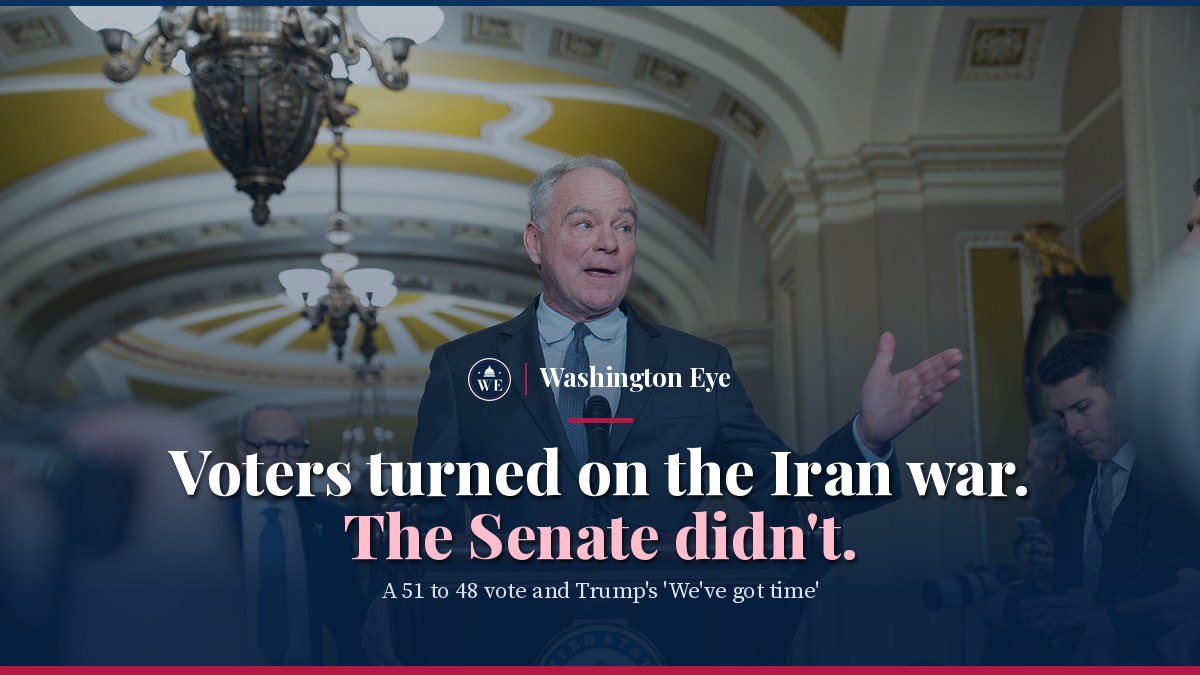
Sixteen days after an election that many in both parties read as a verdict on the war with Iran, the United States Senate was asked a simple question on Thursday: should American forces stop fighting it without permission from Congress? The answer was no, by 51 votes to 48. It was the first recorded vote on the war in either chamber since November 3, and it came out almost exactly where the last one did.
The measure was House Concurrent Resolution 93, sponsored by Representative Seth Moulton of Massachusetts and adopted by the House in mid-September, 220 to 204, with seven Republicans joining Democrats. Under an agreement reached earlier this month, it was pulled out of the Senate Foreign Relations Committee and brought to the floor for up to six hours of debate. The roll call opened at 2:00 p.m. and closed at 2:42 p.m. Washington time.
Three Republicans voted for it: Susan Collins of Maine, Lisa Murkowski of Alaska and Rand Paul of Kentucky. One Democrat, John Fetterman of Pennsylvania, voted against it. Chris Murphy of Connecticut, who is recovering from a stroke he suffered last month, did not vote. The rest of the chamber split along party lines.
Within hours, President Trump made clear that the vote had not changed his timetable either. Asked in an interview aboard his plane home from China whether new strikes on Iran were coming, he said: "Well, I'll talk to you about it after the beginning of the year." Then he added: "We've got time."
The vote that moved, and the one that did not
The arithmetic matters because September's version of this fight came within a single vote. That roll call failed 49 to 50, with four Republicans crossing over. Washington Eye set out the numbers earlier this week: run the same lineup with full attendance and the Senate would have tied, putting the deciding vote in the hands of Vice President JD Vance, who has said the war cost his party the election.
That scenario never arrived, because the fourth Republican changed sides. Senator Thom Tillis of North Carolina, who voted yes in September and is retiring when this Congress ends, voted no on Thursday. His explanation was about form rather than substance. "This one doesn't go to the president, so it's just a statement from Congress," he told reporters. "I've made that statement. I don't need to vote on a Democrat resolution to make that statement." He also suggested the repeated votes were becoming fruitless and that there should be "more weight on solving the fundamental problem."
Senator Bill Cassidy of Louisiana, who backed a similar resolution in June shortly after losing his Republican primary, also voted no, as he did in September. Mr. Murphy's absence cost Democrats another vote. Even with him present and Mr. Tillis back on side, the count would have been 50 to 50, and a tie fails.
Mr. Tillis's point about the measure's legal weight is real. A concurrent resolution is never sent to the president, so he cannot veto it, but administrations of both parties have long argued that this route under the War Powers Resolution of 1973 cannot bind them, and a 1983 Supreme Court ruling against legislative vetoes is the main reason most lawyers agree. The Senate has already passed one such measure this year, in June. The White House answered at the time that there were "no present hostilities" from which to remove American forces, because the fighting that began on February 28 had ended with a ceasefire the president ordered on April 7.
What each side argued
Supporters framed the vote as a test of whether the Senate had heard the election. "The American public is tired of it," said Senator Tim Kaine of Virginia, who has led the war powers effort all year. "The American public is also tired of escalating gasoline prices and diesel prices, and other things that have gone up and punished Americans since the war." Speaking outside the chamber, he put the constitutional case more bluntly: "Who has the power to declare war? Only one branch, Article One." When both houses have called the war illegal, he said, the message is "Stop it, or get an authorization. The president can't veto the Constitution."
Opponents argued that the country should not signal retreat in the middle of a confrontation. Senator Tim Sheehy of Montana, the last speaker before the roll call, said the United States should "finish the job, protect this nation and protect our allies." Republicans have acknowledged that high fuel prices have hurt them politically but have called the repeated votes a distraction from the conflict itself.
The public mood is not hard to read. A wire service's large survey of more than 100,000 voters found that about six in ten said the United States made the "wrong decision" in taking military action against Iran, and most of those voters backed the Democratic candidate in their House race. Mr. Vance wrote after the election that the war was one of the reasons the party lost. Mr. Trump has not disputed that. "JD was fine," he said on Thursday. "What he said was right." But asked whether he would do it again, he was just as clear: "The answer is yes. Because you can't let Iran have a nuclear weapon."
A war that is waiting, not ending
Mr. Trump's comments on Thursday fit a pattern. Before the midterms he repeatedly suggested Iran would be more willing to deal once the election was over. In a television interview aired the same day, he said, "We'll see what happens after January 1," and told a US news site, "I'm not rushing to make any decisions on Iran." His administration said last week that it believes its naval blockade and economic sanctions are working.
On the water, the war has not gone quiet. Iranian attacks on ships in the Strait of Hormuz have escalated in recent days, and three American carrier groups are now in the region enforcing the blockade. Mr. Trump also played down a report this week that Iran was planning to detonate a radiological "dirty bomb" in Washington, saying "I don't think so" when asked whether residents of the capital should be alarmed, while claiming without detail that Iran was "looking at gases, looking at bio." Iran's Foreign Ministry called such accusations an attempt to create fear and justify military action.
Notably, the joint statement that came out of the president's summit with the leaders of China and Russia on Thursday did not mention Iran at all. Its four points covered United Nations reform, petroleum supplies, the International Criminal Court and nuclear risk. The war that shaped an American election did not make the page.
Why the next Congress changes the question
Thursday was very likely the last war powers vote of this Congress. When the new one is sworn in on January 3, Democrats will hold the House and 56 seats in the Senate. On paper, a resolution like this one would pass both chambers easily. In practice, that would only repeat what June already showed: the White House can declare the hostilities over and carry on.
Mr. Kaine signalled on Thursday that Democrats know this. "We can't make a president follow the law if he's going to violate the law," he said. "So when we have the gavels, we are contemplating other things, and we're actually contemplating things in connection with the (continuing resolution funding) discussion." That is a reference to the power of the purse. The government is funded only until December 11, and the spending fights of the new year will be the first in which Democrats control what the Pentagon can spend and on what.
That shifts the debate from symbolism to money, and it shifts the risk for both sides. Using funding bills to restrict a war invites a confrontation over shutdowns and over support for troops already deployed, which Republicans will be ready to exploit. Leaving the war alone invites the charge that a party elected partly on ending it chose not to. Mr. Trump's own timetable, which points to some kind of decision after January 1, lands squarely in the opening days of that new Congress.
What to watch
Three things will tell readers whether Thursday's vote was the end of a chapter or the start of a harder one. The first is the December 11 funding deadline, and whether any war-related conditions appear in the stopgap bill or the defense measures moving alongside it. The second is the Strait of Hormuz, where a serious attack on American forces or shipping could force the president's decision earlier than he says. The third is what Mr. Trump actually announces after the new year, and whether he asks the incoming Congress for anything at all.
For now, the result is simple to state. Voters in large numbers said the war was a mistake. The president agrees it hurt his party and says he would do it all again. And the outgoing Senate, given one last chance to put its name to the voters' verdict, declined by three votes.