
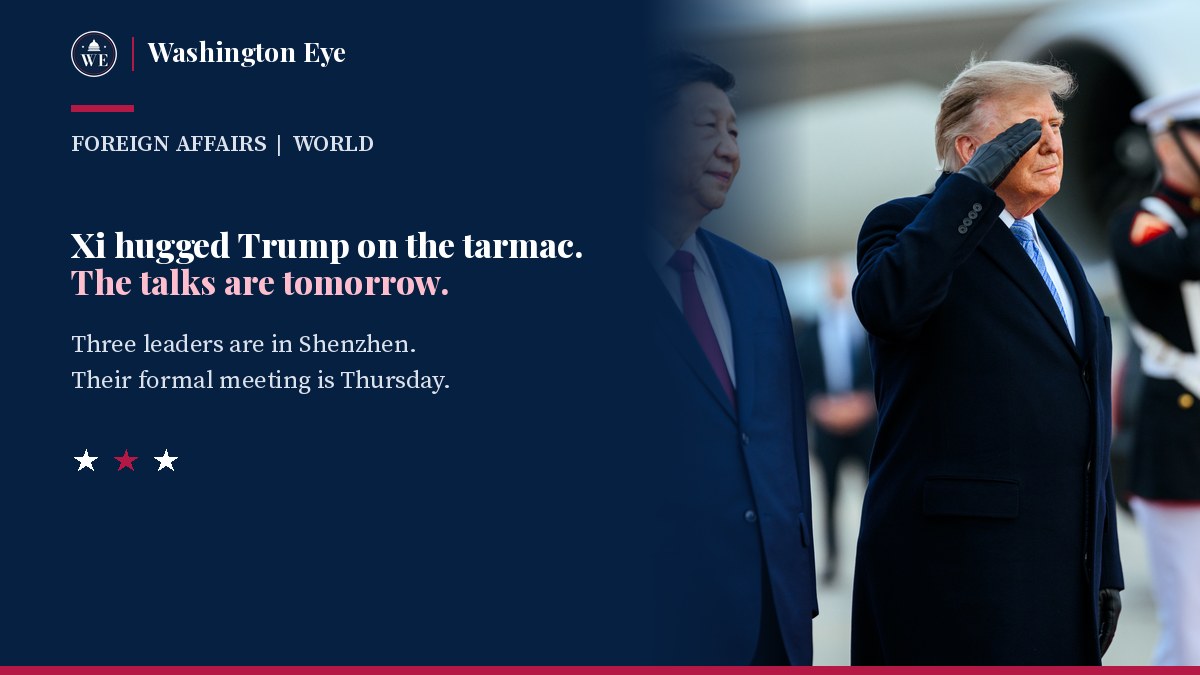
President Donald Trump's plane had barely stopped in Shenzhen on Wednesday when the host of this week's Asia-Pacific summit walked onto the tarmac to meet him. Chinese President Xi Jinping was waiting at the foot of the stairs. The two men shook hands, then shared a brief hug, as a military band played both national anthems and fighter jets flew overhead. A child presented flowers. An honor guard of the three Chinese services stood at attention. Performers waved flags and pompoms along a red carpet.
It was a rare break with protocol, and it was meant to be read as one. Mr. Xi, according to a Chinese government readout, told Mr. Trump he was returning a courtesy: in September, the American president and first lady Melania Trump had made a special trip to Joint Base Andrews to greet the Chinese leader at the start of a state visit. "China is a nation of etiquette with a tradition of reciprocal courtesy," Mr. Xi said. He welcomed Mr. Trump back to China and said he looked forward to "in-depth exchanges" on China-US relations, Asia-Pacific cooperation and the global landscape, so as to "move forward the constructive China-U.S. relationship of strategic stability on the basis of respect, fairness and reciprocity."
Mr. Trump, according to the same readout, thanked Mr. Xi for the personal welcome and the "special arrangement." "I am very happy to visit the great country of China again," he said. "President Xi is a great leader, and every meeting with President Xi has been very pleasant. I believe this visit will further advance the bilateral relationship and achieve a full success."
The three-way meeting that has drawn the world's attention has not started. It is scheduled for Thursday. What happened on Wednesday was the choreography around it: who was met at the airport, who was not, and a handshake later in the evening that will be easy to confuse with the summit itself.
The greeting Putin did not get
Russian President Vladimir Putin had landed in Shenzhen hours earlier, in the early hours of Wednesday. Mr. Xi did not go to the airport. Mr. Putin was met by Cai Qi, a close adviser to the Chinese leader and a member of the Politburo Standing Committee. When Mr. Trump last visited China, in May, it was Vice President Han Zheng who greeted him in Beijing. The upgrade on Wednesday was reserved for the American president. It is believed to be the first time in decades that China's top leader has personally greeted a foreign counterpart on arrival.
The contrast will not have been lost in Moscow, even if the relationship on display later in the day was warm. Before Mr. Trump arrived, Mr. Xi and Mr. Putin held about two hours of talks, their fifth meeting this year, and shared a meal. Mr. Putin said, "We are very glad to be here among friends." Mr. Xi described the China-Russia relationship as "stable as a mountain, unshaken by storms," and both men pledged closer cooperation toward a "multipolar world."
At the opening of the Asia-Pacific Economic Cooperation meetings, also before Mr. Trump landed, the two leaders spoke in public, and they spoke past Washington. Mr. Xi urged support for "free and open trade" and for "the rules-based multilateral trading system with the World Trade Organization at its core." He said China would lower tariffs and open its markets further while standing up against protectionism and unilateralism. Mr. Putin called Western powers "former hegemons," said Europe was in a "humiliating decline," and argued that sanctions imposed after Russia's invasion of Ukraine had backfired.
"Experience has shown that the traditional tools of economic dominance and de facto coercion have largely run their course, having lost much of their intimidating power," Mr. Putin said. "While sanctions, tariffs, and export restrictions may still exert a certain deterrent effect, they are incapable of halting growth, let alone crushing the economies of competitors." He described the world as "turbulent" but said disagreements can be addressed by "sitting at the table." Of Thursday's session he was blunt: "I therefore expect big potential benefit from the upcoming trilateral meeting."
A handshake is not a summit
Later on Wednesday, the three men were in the same room. Mr. Xi welcomed leaders attending the summit. They posed for a group photograph. At a welcome banquet, Chinese television showed Mr. Putin walk up to Mr. Trump, shake his hand and speak with him briefly, with Mr. Xi looking on. It was the first time the American and Russian presidents had met in person since their summit in Alaska in August 2025, a meeting that failed to produce a deal to ease the war in Ukraine.
That handshake matters as a fact of protocol. It is not the meeting the world has been waiting for. The first formal sit-down of the three presidents is still set for Thursday, on the sidelines of the summit. A US official has said Mr. Trump also plans to meet Mr. Putin separately on Thursday. The Kremlin has said the same, and a Kremlin aide, Yuri Ushakov, said the two would have several opportunities to speak in Shenzhen. The form of those talks was still unclear on Wednesday. A Kremlin spokesperson indicated they may be short and informal, without large delegations in the room.
Mr. Trump arrived from Manila, where he had met regional partners and used a stop in the Philippines to emphasize defense cooperation, a sensitive subject given disputes in the South China Sea. He attended the Shenzhen banquet with Secretary of State Marco Rubio, Treasury Secretary Scott Bessent and Commerce Secretary Howard Lutnick. He is also due to hold separate talks with Mr. Xi, the latest in a year of meetings that have kept a fragile trade truce in place even as Washington has tightened restrictions on China's access to advanced artificial intelligence chips and Beijing has pledged to retaliate.
What is on the table, and what is not
A full agenda for Thursday's three-way meeting has not been published. The hints point in three different directions, which is the problem.
Mr. Trump has said he wants to talk about reducing nuclear arsenals and about ending the war in Iran. He has also said Ukraine is on his mind. China's foreign ministry has framed the discussion as one about safeguarding world peace and promoting "strategic stability" among major countries, language that usually means nuclear weapons and the terms of great-power relations, not a peace settlement. Beijing has signaled that it does not want the war in Ukraine as a formal item on the trilateral agenda. Moscow does. Mr. Ushakov said earlier this week that Mr. Putin and Mr. Trump would continue to discuss a settlement when they meet in Shenzhen.
A senior US official, briefing reporters last week, said the three-way meeting was unlikely to produce an agreement, and described it as an "entry point" and "the first conversation." That remains the most realistic expectation. Nothing that happened on the tarmac or at the banquet changes the fact that an immediate deal is not on offer.
Ukraine will not have a seat at the table, a point this publication set out yesterday. Officials in Kyiv, and some in Europe and in Taiwan, have already said they fear decisions could be taken over their heads. The handshake on Wednesday will feed that anxiety, even if it was only a greeting. The test is still Thursday, and it is whether the three men use the room to talk past the countries whose wars and security are most affected, or whether they keep those subjects on the tracks that include the people who have to live with the result.
What to watch on Thursday
Three questions will tell observers whether Wednesday's warmth was hospitality or a preview.
The first is whether a separate Trump-Putin meeting actually happens, and whether Ukraine is discussed there rather than, or as well as, in the three-way session. A one-on-one is the more natural place for that conversation, and it is the format Moscow has been pushing.
The second is whether Mr. Xi, having gone out of his way to honor Mr. Trump at the airport, uses the formal session to steer the talk toward trade, technology and "strategic stability," and away from Ukraine. China has a reason to keep the temperature down. A further meeting between Mr. Trump and Mr. Xi is already expected in December, at the Group of 20 gathering in Miami.
The third is what, if anything, is said in public afterward. If the three leaders emerge with only general language about peace and stability, Wednesday's images will have been the story. If they emerge with anything that sounds like a plan for Ukraine, Iran or nuclear arms, the countries not in the room will want the details, not the photographs.
On Wednesday night, the photographs were the point. Mr. Xi made sure the American president was greeted like a guest of honor. Mr. Putin made sure he was seen shaking Mr. Trump's hand. The meeting that would give those images meaning has not been held yet.